
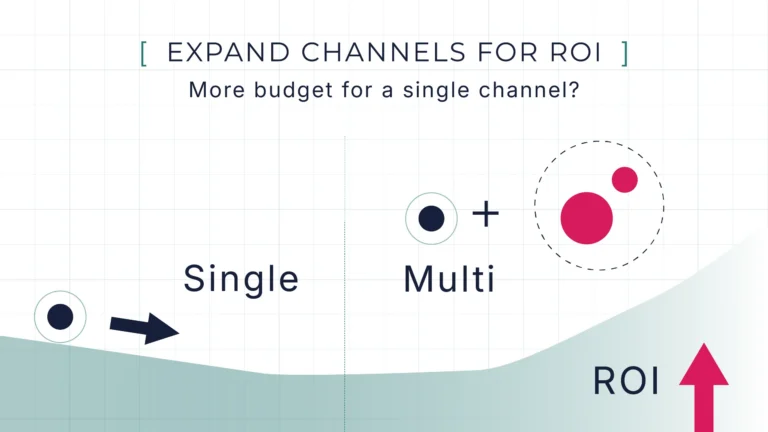
For many Ad managers, they get locked into one channel, often rightly believing the conversion rate is higher so budgets need to be maxed out before even considering adding new ones. Something I believed for a long time too.
The reality being, adding budget to an already saturated campaign can backfire, it risks simply paying for higher positions in the same auctions, rather than bidding in new ones as intended.
For most advertisers, rising cost per click is already a consistent and unavoidable reality. The danger of budget increases is the CPC goes North and campaigns are less effective. The answer is to consider increasing volume by opening new campaigns or channels.
The single channel Google budget increase that backfired
In January 2025, a client’s Google Ads CPC was already trending higher year on year. With an excess of stock, the idea was if more budget is added, they should sell more stock – pro rata right?
After increasing the budget in February, the results showed the CPC was 31% higher than the same period in 2024 (£0.79 vs £0.60). Most of the increase was eaten by the auction dynamics and wasn’t being used to attract new prospects.
This is a classic case of diminishing returns. Adding more money into the same audience pool forced the system to be more aggressive with bids and the outcome was less than ideal.
Expanding reach with Meta
To regain efficiency, I opened a new channel and expanded activity into Meta Ads from March 2025 onwards.
The goal wasn’t just “cheaper clicks.” It was to:
- Spread spend across platforms – to relieve auction pressure in Google and provide more opportunities to reach new prospects
- Sense-check quality – cheap clicks mean nothing unless conversion rates across channels are tracked and used to guide bidding
- Lower the blended CPC – by moving budgets to separate channels, each channel could be optimised more effectively
The surprise results
By April and May, the strategy shift had clearly delivered upon its goal. With overall traffic volume up and CPC down, this looked like a clear win. Unexpectedly, Meta also showed an equal engagement rate despite its lower CPC.
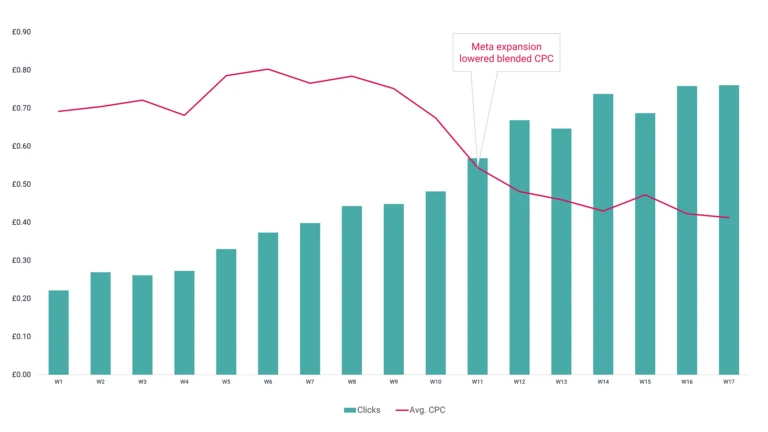
From the chart above we can see:
- Higher overall traffic volumes (teal bars in the chart)
- Lower and stabilised blended CPC (pink line)
For this client, with offline conversion tracking limited, how traffic plays out into sales is more nuanced – so work still needs to be done.
How this can help your business or client
Throwing more budget into a single channel isn’t always the answer. What worked for this account was recognising diminishing returns early and adapting.
What the channel mix ultimately ends up being is still open – yes, one channel will outperform another, but the key here is that there is an optimal price to pay for all traffic. The more traffic in the mix the greater the optimisation opportunity.
Of course, the most important factor is traffic quality and conversion rates. Validating traffic quality to ensure efficiency didn’t come at the expense of relevance. CPC is just one factor in your acquisition journey.